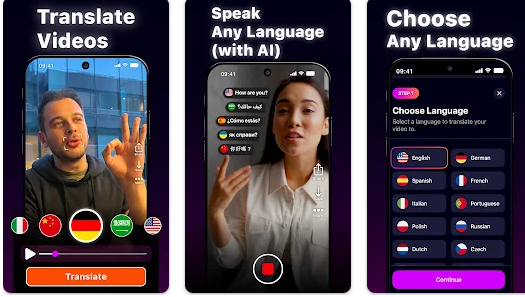
In the ever-expanding world of global content creation, language barriers remain one of the biggest challenges for digital creators, educators, and businesses. Thankfully, artificial intelligence (AI) has introduced powerful solutions — one of the most impactful being the AI Video Translator. This tool enables seamless translation of spoken dialogue in videos into multiple languages, allowing users to reach wider audiences without re-recording or hiring multiple voice actors. In this article, we’ll explore what an AI Video Translator is, how it works, its features, pros, cons, and top alternatives.
What is the AI Video Translator?
An AI Video Translator is a tool or software that utilizes artificial intelligence to automatically translate spoken content in a video from one language to another. Unlike traditional manual translations, AI-powered translators analyze video audio, transcribe it, translate the content, and can even generate lip-synced or subtitled versions in different languages — all automatically.
These tools are commonly used in:
-
Educational videos
-
Marketing and promotional content
-
YouTube and social media videos
-
Online courses
-
Business training modules
Modern AI Video Translators rely on advanced natural language processing (NLP), automatic speech recognition (ASR), and neural machine translation (NMT) systems to deliver accurate and natural-sounding translations.
How AI Video Translator Works
The working mechanism of an AI Video Translator typically follows these core steps:
1. Speech Recognition (ASR)
The system starts by detecting and transcribing the spoken words from the video. It converts audio speech into written text using ASR technology.
2. Language Detection
The tool identifies the source language used in the video, which is essential for accurate translation.
3. Translation (NMT)
Using neural machine translation, the transcribed text is translated into the desired language. AI models ensure the context and nuances are preserved.
4. Voice Generation / Subtitling
Depending on the feature set:
-
A translated voice-over is generated with natural speech synthesis.
-
OR subtitles are added to the video.
Advanced platforms also offer lip-syncing to make the new translation match the speaker’s mouth movements.
5. Final Output
The output is a multilingual version of the original video, either in dubbed format, with subtitles, or both — ready for distribution across global platforms.
Features of AI Video Translator [Completely Detailing]
Modern AI video translation tools come with a wide range of advanced features. Below is a comprehensive breakdown:
| Feature | Description |
|---|---|
| Multi-Language Support | Support for 50+ languages including English, Spanish, Hindi, Chinese, etc. |
| Automatic Transcription | Transcribes speech from the video into accurate text. |
| Voice Cloning | Retains the original speaker’s tone and pitch during dubbing. |
| AI Lip Sync | Matches translated audio with lip movement for a natural look. |
| Subtitles & Captions | Automatically adds translated subtitles with customization options. |
| Batch Processing | Allows processing of multiple videos at once, saving time. |
| Cloud-Based Editing | Enables editing and managing translated videos from anywhere. |
| Drag-and-Drop Interface | User-friendly tools for importing, translating, and exporting videos. |
| Speaker Identification | Differentiates between speakers for clearer dialogue translation. |
| Noise Filtering | Enhances voice clarity before transcription and translation. |
| Pros | Description |
|---|---|
| Time-Saving | Automated translation eliminates hours of manual work. |
| Cost-Efficient | Reduces the need to hire human translators or voice actors. |
| Scalable | Allows translation of hundreds of videos quickly for large-scale projects. |
| Multilingual Reach | Helps creators tap into international audiences. |
| Customizable Output | Subtitles, dubbing, and voice cloning allow flexible content creation. |
| Accurate & Contextual Translations | AI understands context, slang, and idioms better than older systems. |
| Cons | Description |
|---|---|
| Limited Accuracy in Complex Content | Highly technical or emotional content may still require human editing. |
| Subscription Costs | Premium tools may require monthly fees or per-minute charges. |
| Privacy Concerns | Uploading sensitive videos to cloud-based tools could raise data security issues. |
| Voice Tonality Limitations | Some tools may not perfectly replicate emotions or intonations. |
| Dependency on Internet | Cloud-based platforms need a stable internet connection for processing. |
If you’re exploring options beyond your current AI Video Translator, here are some powerful alternatives:
| Tool | Key Features | Free/Paid |
|---|---|---|
| Veed.io | Subtitling, voice dubbing, supports 100+ languages, online editing tools. | Freemium |
| Kapwing | Translate, subtitle, and edit videos online. Easy drag-and-drop editor. | Freemium |
| HeyGen AI | Realistic AI avatars and voice dubbing with lip sync. Best for professional use. | Paid |
| Descript | Podcast + video editor with powerful transcription and translation. | Freemium |
| Synthesia | AI avatars, automatic translations, professional video creation. | Paid |
| Nova AI | One-click subtitle translation, works well for creators and educators. | Freemium |
AI Video Translators are rapidly transforming how we consume and produce global video content. Whether you are a YouTuber, online educator, marketing agency, or multinational business — these tools can help you:
-
Break down language barriers
-
Reach global markets
-
Increase accessibility for deaf or hard-of-hearing viewers
-
Repurpose existing content into multiple languages effortlessly
However, while the technology is evolving fast, it’s still not perfect. For emotionally nuanced storytelling, sarcasm, or high-context cultural content, human editing or review is still recommended. Nevertheless, AI Video Translators represent a bold leap forward for international communication and media production.